A measurement plan for your user conference, start to finish
Five steps from the first planning meeting to the 365-day report: what to decide before registration opens, what to set up in the CRM, what to record on the days and what to count after.
By CordiallyPublished · 13 min read
The short answer
A user conference measurement plan is the set of decisions you write down before registration opens: what the conference is for with customers and with prospects, which accounts count, how sourced and influenced pipeline are defined, the reporting window, the cost lines and a comparison group. Then set up the CRM, record who met whom on the days, and report at fixed checkpoints.
What is a user conference measurement plan?
A user conference measurement plan is a short document, agreed with sales, customer success and finance, that says what the conference is meant to change, how each change will be counted and when the counting happens. It is written months before the event and used, unchanged, for every report after it.
Definition
The measurement lock is the set of decisions written down and agreed before registration opens: the goal for each audience, the frozen account list, the definitions of sourced and influenced pipeline, the reporting window, the cost lines and the comparison group. Anything decided after the event goes in the report as a change, with the date.
Most event teams already measure something, and many disagree with their leadership about what counts as success. Forrester's Q1 2026 State Of B2B Events Survey of over 400 event decision-makers found that "around half of organizations say their events are performing well, just 38% of CMOs agree". A plan signed before the event is how the field marketer and the CMO end up reading the same result.
Write the rules before registration opens. Decided after the event, every rule looks like a choice of answer.
This guide follows one event, the user conference, from the first planning meeting to the report a year later. It draws on five earlier guides and links to each where it goes deeper.
Why does a user conference need its own measurement plan?
A user conference needs its own plan because much of the room is already a customer, and a lead-generation scorecard misses what a conference does for customers. The same hall holds customers up for renewal, accounts with open deals and a few prospects your sales team brought along. Each group answers a different question.
Forrester found that for over half of organizations net-new lead generation is the primary objective for events, and warned about what that does to measurement:
“While this revenue focus is understandable, it risks undervaluing the broader value that an event delivers. It also drives overly simplistic measurement and post-event follow-up that fail to reflect how B2B buying actually happens.”
In The CMO Survey 2026, 56% of 308 U.S. marketing leaders said they feel increasing pressure from their CFO to prove the value of marketing, down from 63% in 2025. Bizzabo's 2026 trends post says "In 2026, 40% of organizers report difficulty proving event ROI, compared to 70% in 2025." Bizzabo publishes no sample for that comparison, so read the two years as separate surveys.
If the user conference is your biggest event of the year, with the largest budget and the most people from each account, a lead count leaves the renewal conversations and the executive who flew in for the keynote with no trace in the report.
How do you build the plan? Five steps
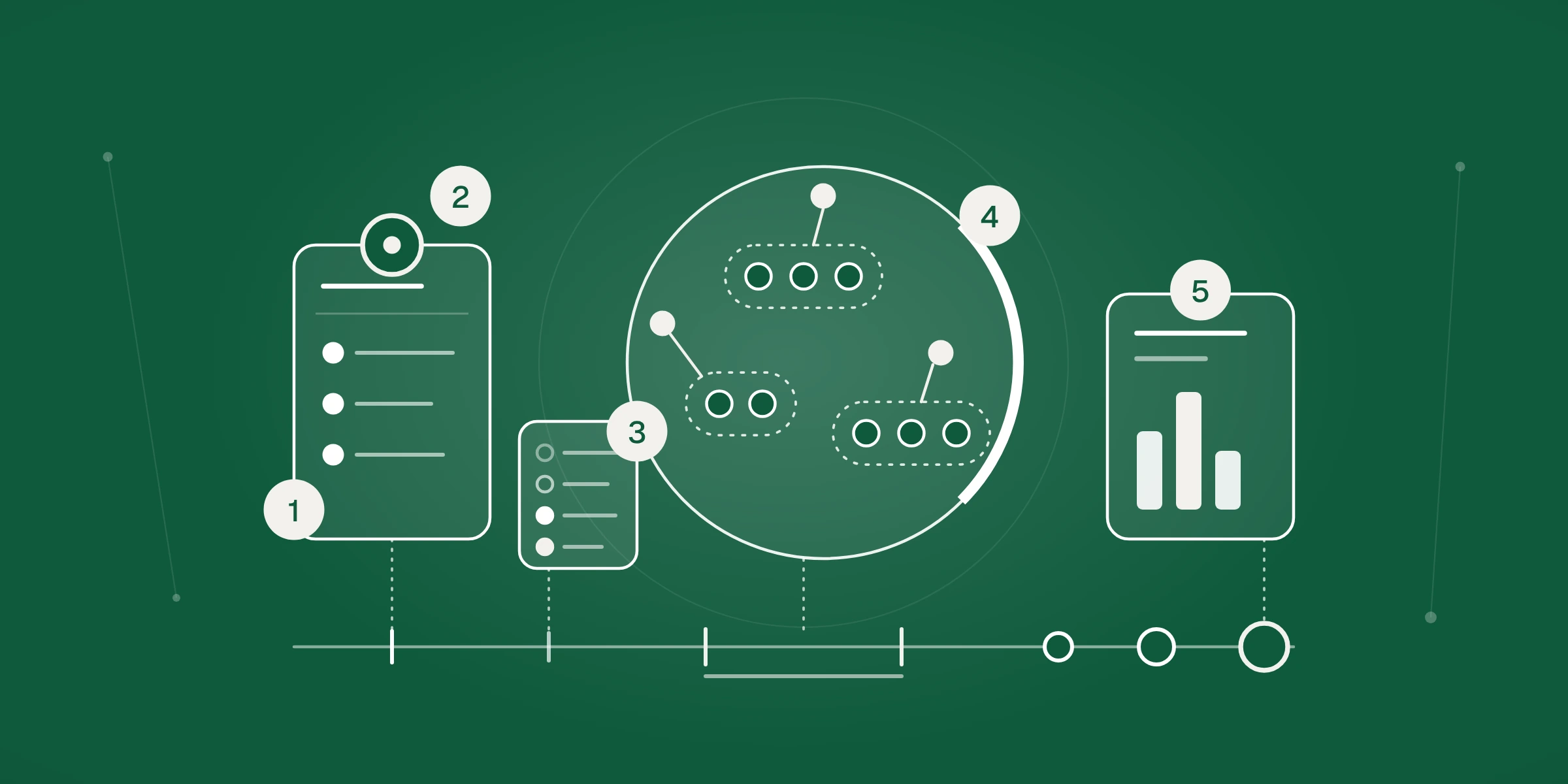
Decide what the conference is for, lock the rules, set up the CRM, record the room by account, then clean up and report at fixed checkpoints. The first three steps happen before a single invitation goes out.
Leak 1: Decide what the conference is for, by audience
Split the guest list into three groups and give each its own goal and its own metric. One blended number for a room that is mostly customers will hide the result you care about most.
| Audience | The question | What to count | Where it lives |
|---|---|---|---|
| Customers with a renewal or expansion in the window | Did the conference help keep or grow the account? | Renewal and expansion opportunities at attending accounts, against invited accounts that did not attend | The renewal or expansion opportunity, owned by the account manager |
| Accounts with an open deal | Did the conference move the deal? | Stage changes and closed-won revenue at attending accounts inside the window, reported as influenced | The open opportunity and its contact roles |
| Prospects with no open deal | Did the conference create pipeline? | Opportunities created inside the window at attending accounts, reported as sourced | New opportunities, with the event recorded as their source |
The split is our suggestion. No study we found measures which goals user conferences set, so adjust the groups to your own book of business. Write one sentence per audience, such as "Customers with a renewal in the next two quarters: renewal pipeline at attending accounts against invited accounts that did not come."
Experience metrics such as session ratings and survey scores belong in the plan too, on their own line. They tell the content team what to repeat, and they stay out of the pipeline totals.
Leak 2: Lock the rules before registration opens
Write down six decisions, get sales, customer success and finance to agree, and date the document. Bizzabo, a registration vendor, puts the reason plainly in a February 2026 post: "teams often fail to align definitions across departments. Sales, marketing, and event teams must agree on what constitutes engagement, qualification, and success."
- The account list. The target accounts for each audience, frozen on the day registration opens. Accounts added later go in their own column, labelled as added.
- Sourced and influenced. One rule for each. The simplest is the creation test: if the opportunity record existed before the conference, the conference influenced it at most.
- The window. The main window and the checkpoints you will report at. See the timeline below.
- The cost lines. Everything the conference costs, including your own team's time.
- The comparison group. Invited accounts that did not attend, reported beside the attending ones as a reference.
- The owner. One named person who keeps the plan, runs the reports and records any change with its date.
On the window, Vendelux, an event-intelligence vendor, recommends a 180-day lag for revenue in its return-on-event-investment formula, "(closed-won revenue attributed to the event, lagged 180 days) ÷ total all-in event spend", and says longer windows of 365 days "are harder to defend operationally". That is one vendor's view. We found no independent benchmark for how long an event takes to produce a deal, so set your own main window, state it, and show 60, 180 and 365 days as checkpoints.
On cost, Vendelux's list for sponsored events is a fair start for a hosted one: "staff time, travel, T&E, booth build, sponsored dinner, swag, post-event follow-up resourcing." For a user conference add the venue, production, catering, speakers and any agency. HubSpot's campaign ROI subtracts spend before dividing, "((revenue, attributed revenue, or associated deal value - campaign spend total)/campaign spend total) * 100", while Vendelux divides revenue by spend. Pick one formula, name it in the plan and keep it.
If two people can run the report and get different numbers, the plan is not finished.
Leak 3: Set up the CRM before invitations go out
Create the conference in the CRM before the first invitation, with statuses that separate invited, registered, attended and met, because both CRMs credit an event through the contacts on a deal. Set it up late and the first weeks of registrations arrive with nothing to attach to.
In Salesforce, the conference is a campaign. Salesforce describes the rule that decides what its influence reports show:
“Influence models scan active campaigns to identify members who are also assigned a contact role on an open opportunity.”
The same page says "Campaign Influence considers every campaign member, regardless of their member status", so an invited guest who never came counts the same as one who spent two days with your team unless your reports filter by status. Add an attended status and a met status, and report on them.
In HubSpot, an in-person conference is a marketing event you create by hand and fill by importing participants. HubSpot's documentation says contacts "can't be manually associated with marketing events from a contact record"; they join through participant status changes from an import, a workflow action or a connected app. Using event attendance in revenue attribution needs Marketing Hub Enterprise, with the "Marketing event registered" and "Marketing event attended" sources switched on. Then "If a contact is associated with a closed-won deal, any marketing events that they attended or registered for will receive credit for driving revenue." Campaign revenue follows the same rule: "For attribution, the deal must be associated with at least one influenced contact."
Both CRMs give credit only through people attached to a deal. Why that leaves many event reports empty, and the fixes, are in why your CRM shows no event influence.
Leak 4: Record the room by account
On the conference days, record who from each target account checked in, who on your team met them and what they said, written to the CRM the same day. Check-in data gives you attendance. Your team's conversations give you everything else, and nobody writes them down unless the plan says how.
Give each key account a host from your team before the doors open. Use one CRM activity per conversation with three lines: who it was, what they said, what happens next. The format and the end-of-day check are in the same-day CRM logging checklist. Create any guest who is missing from the CRM as a contact on the day, attached to the account.
The missing contacts are a known gap outside events too. Ebsta and Pavilion's 2025 GTM Benchmarks, built on 655,000 opportunities, found that 44% of the contacts sellers interact with aren't recorded in their CRM, and that a quarter of those are CxO, VP or Director level. Ebsta sells revenue-intelligence software and the report covers selling in general, so use it as a reason to check your own guest list against your contacts.
Watch for the four places pipeline slips away on the day: a signal that never reaches the account owner, a key account nobody meets, a conversation nobody logs and a guest the CRM never credits. Each one is described in the pipeline your team misses at your own events.
Leak 5: Clean up in week one and report at checkpoints
In the first week, attach every attending guest to their account's open deals with a contact role, mark attended and met statuses, and close the cost sheet. Then report at each checkpoint with the same rules and the same account list.
The deadline in week one comes from the CRM. Salesforce says "After an opportunity’s stage is closed (won or lost), influence records are no longer created", so a guest added to a deal after it closes earns the conference nothing for it. HubSpot credits through contacts associated with the deal, so the same cleanup applies there. In the same week, ask every host who logged no conversations whether they met anyone from their accounts. A blank row can mean a guest nobody met, or a conversation that is still in someone's notes, and only the host knows which.
| When | What happens | Who owns it |
|---|---|---|
| Before registration opens | Goals by audience, the measurement lock signed, account list frozen | Field marketing, with sales, customer success and finance |
| Before invitations go out | Campaign or marketing event created, statuses set, hosts assigned to key accounts | Marketing operations |
| The conference days | Check-in synced, one CRM activity per conversation, missing contacts created | Every host on the floor |
| Week one | Guests attached to open deals with contact roles, statuses cleaned, cost sheet closed | Marketing operations and account owners |
| 60 days | First report: accounts reached and covered, sourced pipeline, deals moved | The plan's owner |
| 180 days | Main report: closed-won revenue, renewals and expansions, ratio to cost | The plan's owner, reviewed with finance |
| 365 days | Final report, and the inputs for next year's plan | The plan's owner |
In Salesforce, a guest added to a deal after it closes earns the conference nothing for that deal.
What should the user conference report show?
The report should show the plan's rules at the top, then one block per audience with the attending accounts beside the comparison group, and the cost and ratio at the end. A reader who disagrees with a number should be able to find the account it came from.
- The rules: window, definitions, cost lines and formula, copied from the measurement lock, with any change and its date.
- Accounts reached and covered: target accounts with at least one attendee, and those where someone on your team spoke to a guest and wrote it down.
- Customers: renewal and expansion pipeline and revenue at attending accounts, beside invited accounts that did not attend.
- Open deals: stage changes and closed-won revenue at attending accounts, labelled as influenced.
- Prospects: opportunities created inside the window, labelled as sourced under your rule.
- Cost and ratio: all-in cost, the ratio you chose and the CRM's own campaign figure beside it, because finance can reproduce that one.
Lead with the conservative numbers, sourced pipeline and closed-won revenue, and say what the method does not prove. Accounts that come to a user conference are often your happiest customers, so a better renewal rate at attending accounts is an association. The comparison group shows the size of the gap without proving the conference caused it. How to build the account-by-account record behind each total is in how to prove event ROI at account level.
For prospects, count by buying group as well as by account. Forrester's State Of Business Buying, 2026, from a survey of nearly 18,000 buyers, reports that 13 internal stakeholders influence a buying decision on average. One champion at the keynote and nobody else from the account is a different result from three roles at the same table. Who to invite from each group is in what a buying group is.
What about the ROI benchmarks you see quoted for conferences?
Treat them as unsupported until you find the study behind them. A search on November 16, 2026 for user conference measurement returned two 2026 guides with confident numbers. Webmobi's says "A healthy paid B2B conference creates pipeline of 3–10× the event cost" and that measuring created pipeline alone "understates total impact by 40–70%". GTMStack's says "A 10:1 ratio is a reasonable benchmark for mid-market B2B". Neither page links a study or gives a sample for these figures.
The one recent survey figure close to the question is about tooling. Forrester reports that two-thirds of organizations have integrated their primary event platform with their sales and marketing stack, and that 62% of those with deep integration are satisfied with event performance against 37% of those without. The survey measures satisfaction and shows an association. It supports the CRM setup in step 3 and gives no figure for the return to expect.
Your own first conference under the plan becomes your baseline. Next year's plan compares against it, with the same rules, which is more useful to finance than any figure from someone else's events.
Where does Cordially fit in the plan?
Step 4 is the hardest to staff, because the people who need to record the room are the ones busy talking to it. Cordially Agents start from your guest list and check-in, show your team which key accounts are on site and who has and hasn't met them, line up the right person, and write each conversation to your CRM tagged to the conference. That fills the met-by and what-was-said columns the report depends on. Every message an agent drafts to a guest is approved by a named teammate before it sends.
Frequently asked questions
When should I start the measurement plan for a user conference?
Before registration opens. The account list, the definitions of sourced and influenced pipeline, the window and the cost lines all have to be fixed before results exist, or they look chosen to fit them. Set up the campaign or marketing event in your CRM before the first invitation goes out.
What metrics should I track for a user conference?
Track separate metrics for each audience. For customers, renewal and expansion pipeline at attending accounts. For open deals, stage changes and closed-won revenue, reported as influenced. For prospects, opportunities created inside the window, reported as sourced. Add accounts reached and covered, all-in cost, and session ratings on their own line.
How long after a user conference should I measure revenue?
Set the main window before the event and report at checkpoints. Vendelux recommends a 180-day lag for revenue and calls 365 days harder to defend. We found no independent benchmark, so report at 60, 180 and 365 days with the same rules, and state the window at the top of every report.
Should customers at a user conference count toward event ROI?
Yes, on their own line. Renewal and expansion at attending customer accounts are part of what a user conference is for. Report them beside invited customers that did not attend, label the comparison as a reference, and keep them out of sourced pipeline, which is for opportunities the conference created.
What is a comparison group for an event?
It is the set of invited target accounts that did not attend, reported beside the accounts that did. It shows what the same list did without the event. Accounts that accept are often warmer than those that decline, so present the comparison as a reference that cannot prove cause.
Do I need Marketing Hub Enterprise to measure an event in HubSpot?
To use marketing event attendance in HubSpot's revenue attribution reports, yes: HubSpot says that needs Marketing Hub Enterprise. On any plan you can still create the in-person event and import participants, and on Professional associate it with a campaign. Either way, attending guests must be associated with the deal for revenue credit.
Sources
Every number in this guide comes from the sources below, checked against the source itself on the date shown. Cordially has no customer outcome data yet, so none is used.
- The Next Era Of B2B Events: Eight Data-Backed Shifts Defining 2026Forrester (Conrad Mills, Rosa Tardio), June 25, 2026Used for: Q1 2026 State Of B2B Events Survey, over 400 event decision-makers: about half say events perform well against 38% of CMOs; lead generation the primary objective for over half; two-thirds integrated; 62% against 37% satisfiedChecked November 16, 2026
- The CMO Survey: Highlights and Insights Report, 2026The CMO Survey (Duke Fuqua School of Business, Deloitte, American Marketing Association), April 15, 2026Used for: 56% of marketing leaders report increasing pressure from the CFO to prove the value of marketing, against 63% in 2025 (308 U.S. marketing leaders, fielded January 2026)Checked November 16, 2026
- Event Industry Trends 2026: What Event Professionals Are ReportingBizzabo (Kerri Moore), February 18, 2026Used for: 40% of organizers report difficulty proving event ROI in 2026, against 70% in 2025 (no sample published)Checked November 16, 2026
- Conference Attendee Tracking That Drives Real PipelineBizzabo (Kerri Moore), February 11, 2026Used for: Sales, marketing and event teams must agree on what constitutes engagement, qualification and success (vendor blog)Checked November 16, 2026
- How to Measure Event Marketing ROI in 2026Vendelux (Stefan Deeran), May 27, 2026Used for: ROEI as closed-won revenue lagged 180 days over all-in spend; 365 days harder to defend; the all-in cost lines (vendor guidance, no sample)Checked November 16, 2026
- How Customizable Campaign Influence WorksSalesforce HelpUsed for: Influence needs a campaign member with a contact role on an open opportunity; every member counts regardless of status; no influence records once an opportunity closes (the page shows no date)Checked November 16, 2026
- Use marketing eventsHubSpot Knowledge Base, August 26, 2026Used for: In-person events created by hand with imported participants; contacts join through status changes; Marketing Hub Enterprise required for revenue attribution; attended or registered events credited on closed-won dealsChecked November 16, 2026
- Analyze individual campaign performanceHubSpot Knowledge Base, August 3, 2026Used for: The campaign ROI formula; a deal must be associated with at least one influenced contact for attributionChecked November 16, 2026
- The State Of Business Buying: Risk-Averse Buyers Demand Proof, Not PromisesForrester, January 21, 2026Used for: 13 internal stakeholders influence buying decisions on average (survey of nearly 18,000 business buyers)Checked November 16, 2026
- Measuring event ROIWebmobi, March 12, 2026Used for: Quoted as an example of an unsourced benchmark: pipeline of 3–10× cost, a 40–70% undercount (no study or sample on the page)Checked November 16, 2026
- Event marketing ROI measurement guideGTMStack, March 17, 2026Used for: Quoted as an example of an unsourced benchmark: a 10:1 influenced pipeline ratio (no study or sample for it on the page)Checked November 16, 2026
- GTM Benchmarks Report 2025Ebsta and Pavilion, 2025Used for: 44% of the contacts sellers interact with aren't recorded in their CRM, and a quarter of those are CxO, VP or Director level (655,000 opportunities; Ebsta is a vendor; selling in general, not events)Checked November 16, 2026
Revision history
- : First published.